
Tuesday, December 29, 2009

Saturday, December 19, 2009

Thursday, December 17, 2009

Scientists spot nearby 'super-Earth'
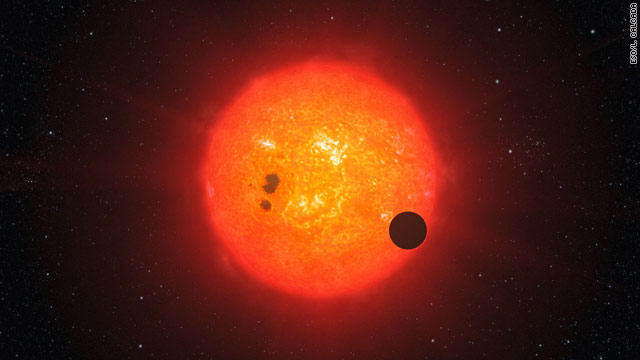
"(CNN) -- Astronomers announced this week they found a water-rich and relatively nearby planet that's similar in size to Earth. [...] "The big excitement is that we have found a watery world orbiting a very nearby and very small star," said David Charbonneau, a Harvard professor of astronomy and lead author of an article on the discovery, which appeared this week in the journal Nature. The planet, named GJ 1214b, is 2.7 times as large as Earth and orbits a star much smaller and less luminous than our sun. That's significant, Charbonneau said, because for many years, astronomers assumed that planets only would be found orbiting stars that are similar in size to the sun. [...] Charbonneau said it's unlikely that any life on the newly discovered planet would be similar to life on Earth, but he didn't discount the idea entirely."
Ok so, nuevo planeta. Se me hace bastante egocéntrica y absurda la idea de que los científicos crean que no hay vida en otros planetas porque no hay agua. ¿Quién dice que solamente con agua sobreviven los organismos? ¿Qué tal si en otro planeta hay seres que sobreviven con algún gas y tienen todo otro mundo? El hombre con toda su tecnología es excesivamente pobre en conocimiento...Me gustaría saber qué más hay aparte de esto, en fin.
(via J.)
Saturday, December 12, 2009

Wednesday, December 9, 2009


Tuesday, December 8, 2009


Monday, December 7, 2009

Thursday, December 3, 2009

Wednesday, December 2, 2009
Tuesday, December 1, 2009
Yahoo Respuestas...

¿Te ha pasado?
"Some call it "phantom vibration syndrome." Others prefer "vibranxiety" — the feeling when you answer your vibrating cellphone, only to find it never vibrated at all."
Psychologically, the key to deciphering phantom vibrations is "hypothesis-guided search," a theory that describes the selective monitoring of physical sensations, says Jeffrey Janata, director of the behavioral medicine program at University Hospitals in Cleveland. It suggests that when cellphone users are alert to vibrations, they are likely to experience sporadic false alarms, he says.
"You come armed with this template that leads you to be attentive to sensations that represent a cellphone vibrating," Janata says. "And it leads you to over-incorporate non-vibratory sensations and attribute them to the idea that you're receiving a phone call."
Alejandro Lleras, a sensation and perception professor at the University of Illinois at Urbana-Champaign, adds that learning to detect rings and vibrations is part of a perceptual learning process.
"When we learn to respond to a cellphone, we're setting perceptual filters so that we can pick out that (ring or vibration), even under noisy conditions," Lleras says. "As the filter is created, it is imperfect, and false alarms will occur. Random noise is interpreted as a real signal, when in fact, it isn't."
Phantom cellphone vibrations also can be explained by neuroplasticity — the brain's ability to form new connections in response to changes in the environment.
When cellphone users regularly experience sensations, such as vibrating, their brains become wired to those sensations, Janata says.
"Neurological connections that have been used or formed by the sensation of vibrating are easily activated," he says. "They're over-solidified, and similar sensations are incorporated into that template. They become a habit of the brain."
Fuente


Subscribe to:
Posts (Atom)

